
The SBTi Corporate Net-Zero Standard: What the Second Draft Means for CDR

Date: December 10, 2025
Author: Bjorn De Groote, Director of Carbon Solutions

Last month, the Science Based Targets Initiative (SBTi) released a new V2 Draft of its Corporate Net-Zero Standard that now integrates carbon dioxide removal (CDR) in corporate net-zero planning. Here are six things sustainability professionals should know:
New “ongoing emissions responsibility” recognitions: Companies can opt in to using carbon credits and/or internal carbon pricing before 2035.
A new mandatory disclosure: Companies must publicly disclose whether they opt in or not, creating a new decision point that requires budget planning and executive alignment.
CDR becomes a requirement as of 2035: The draft proposes a mandatory removals responsibility from 2035 onward, with an increasing percentage of durable removals required over time.
Value chain CDR collaboration is now on the table: The draft explicitly supports sharing Scope 3 responsibility between suppliers and customers, enabling joint CDR procurement.
Dual claiming is restricted: Companies can’t use CDR credits for neutralization if those same credits also count towards a country’s climate goals, which can increase the total cost of net zero.
Uncertainty remains: Post-2035 CDR purchase ramp-up requirements and CDR credit durability requirements are still under discussion. These choices will materially shape corporate CDR needs.
This blog covers the key changes to the SBTi V2 Draft, what CO280 believes needs to be addressed before the draft is finalized, and how SBTi-aligned companies can prepare.
Remember: The SBTi V2 Draft consultation period will remain open through this Friday, December 12, giving companies a final opportunity to submit feedback and help share the future of CDR in a science-aligned, financially feasible framework.
Don’t know where to start? CO280’s team of carbon removal experts has developed an SBTi CDR Procurement Calculator to help you model your corporate decarbonization pathway and understand your CDR needs through 2035 and beyond. Contact us for a free consultation.
The SBTi Draft Corporate Net-Zero Standard V2:
Changes Explained
SBTi introduces new responsibility pathways before and after 2035
The SBTi V2 Draft introduces a new framework: ongoing emissions responsibility. This framework creates an optional recognition pathway before 2035 and outlines a mandatory responsibility after 2035, clarifying how companies can address ongoing Scope 1 – 3 emissions on the path to net zero with CDR. At net zero, companies are required to fully neutralize residual emissions with carbon removals.
Before 2035, the SBTi V2 Draft outlines an optional recognition system for corporations, made up of two tiers:
Recognized, where corporations take responsibility for at least 1% of ongoing emissions by purchasing verified mitigation outcomes (e.g. CDR credits) or by applying a minimum internal carbon price of USD $20 and directing that budget to eligible climate actions.
Leadership, where corporations apply a minimum internal carbon price of USD $80 and use it to deliver mitigation outcomes equivalent to at least 40% of ongoing value chain emissions.
After 2035, the SBTi V2 Draft introduces a mandatory requirement for companies to take responsibility for an increasing share of their ongoing Scope 1 – 3 emissions through carbon removals, with a rising share of those removals being durable - capable of storing CO2 for centuries to millennia.
While the exact thresholds will be finalized in a future standard revision, illustrative figures suggest a starting point of 1% responsibility in 2025 with a minimum of 17% of removals coming from durable carbon removals. This mirrors the IPCC’s system-level mitigation pathways. However, unlike a like-for-like approach, which aligns neutralization claims with the durability of the underlying emissions, this requirement does not ask companies to match emission types to equivalent storage durations.
SBTi proposes a new mandatory disclosure for CDR responsibility
The SBTi V2 Draft requires companies to disclose whether they will take responsibility for at least 1% of their ongoing Scope 1 – 3 emissions during each target period.
For sustainability teams, this will require significant internal alignment across their organization. Even a 1% commitment carries long-term budget implications, requires advance planning, and executive alignment. The early responsibility disclosure will become a visible marker of corporate climate leadership, as their choice will be publicly displayed on the SBTi dashboard.
SBTi endorses value chain collaboration for CDR
The SBTI V2 Draft proposes new guidance on how CDR can be used within the corporate value chain by allowing companies to share responsibility for ongoing Scope 3 emissions.
In corporate supply chains, a supplier’s Scope 1 emissions become their customer’s Scope 3 emissions (and vice versa). While this is reflected in standard GHG accounting, SBTi and the GHG Protocol have historically offered little direction on how CDR should be treated across corporate boundaries. The new SBTi V2 Draft removes that ambiguity by explicitly allowing companies to share responsibility for their ongoing Scope 3 emissions—as long as safeguards are maintained to prevent double counting.
In practice, this means that CDR purchased by a supplier or customer to address shared emissions can now support both parties’ net-zero goals. This approach, if implemented, will likely accelerate co-procurement models that will enable suppliers and customers to collaboratively invest in CDR.
SBTi prevents dual claiming of CDR credits for corporations and nations
The SBTi V2 Draft restricts dual claiming by preventing companies from applying CDR credits towards emissions neutralization if those same credits also support a country’s Nationally Determined Contribution (NDC).
This creates two new challenges for corporations:
A higher cost to reach net zero, as companies using removals from compliance markets would need to offset the same emissions twice.
Difficulties in long-term planning, as companies rely on multi-year offtakes to secure access to removals and support project financing—but given regulatory uncertainty, it remains unclear whether future credits will qualify under SBTi’s new guidance.
Scientifically, this restriction is not necessary. National inventories currently aggregate corporate emissions reductions within their boundaries. With the right accounting safeguards CDR can be treated similarly. Notably, CO280 and over 50 other CDR stakeholders have signed an open letter urging SBTi to revise this position, and we encourage corporates to provide similar feedback during the consultation period.
Learn more: Read CO280's open letter to SBTi
CO280 recommendations for the SBTi Corporate Net-Zero Standard V2
To effectively enable global decarbonization and accelerate corporate climate action, CO280 recommends that:
SBTi adopts a like-for-like approach, to appropriately match CDR durability with emissions durability for credible neutralization.
SBTi enables dual claiming of CDR credits, to unlock scalable public-private collaboration and allow durable CDR to reach commercial scale.
SBTi revises the Leadership recognition criteria, to allow corporate leadership in CDR procurement to be accessible and actionable.
Align durable CDR requirements with a like-for-like approach
The draft does not yet set the required share of durable CDR within emissions responsibility. This will be finalized in a future revision.
For now, SBTi is consulting on two illustrative approaches: 1) aligning with the mix of removals in the IPCC 1.5C consistent pathway, which is based on global, system-level modelling rather than corporate accounting needs; and 2) a like-for-like approach grounded in science-first principles, where long-lived emissions should be neutralized with long-lived removals.
This decision will have significant implications for corporations charting their net zero path, leading to different CDR procurement needs (see Figure 1).

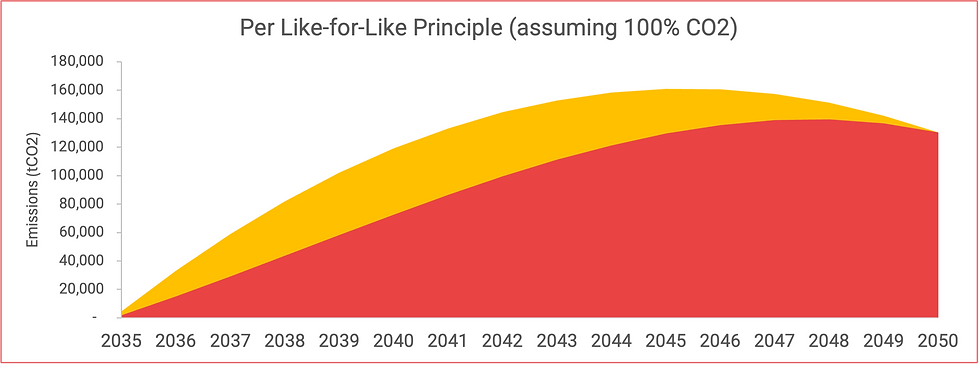
CO280 recommends that SBTi adopts a like-for-like approach. Credible neutralization requires removals with durability equivalent to the emissions they address, a principle widely supported by leading scientific bodies such as the IPCC, GHG Protocol, and Oxford Net Zero Institute. Relying instead on IPCC system-level estimates risks allowing long-lived emissions to be compensated for by short-lived CDR, which could undermine the credibility of corporate climate claims.
A like-for-like approach also aligns with the direction leading compliance markets, such as the U.K. and the EU Emissions Trading Scheme (EU ETS), are moving in as they consider integrating durable CDR into their frameworks.
A Note from CO280: Advancing an Affordable Like-for-Like Framework |
We recognize the main concern on the like-for-like approach: durable CDR is typically more expensive than short-duration storage, which can raise near-term costs.
CO280 is working to address this head-on by offering one of the most cost-competitive permanent CDR solutions today at under $250 per tonne, while charting a path to reach under $100 per tonne.
Ultimately, like-for-like is about scientific credibility. Credible neutralization requires removals that match the durability of the emissions and standards should reflect that principle. We recommend that SBTi accounts for future price expectations and adopts like-for-like targets that support both credible claims and the rapid scale-up of permanent, affordable CDR. |
Enable dual claiming of CDR credits to unlock scalable public–private collaboration
SBTi’s stance on blocking dual claiming, where CDR credits can count toward both corporate and national goals, creates unnecessary friction and actually risks duplicating efforts. With the right safeguards, allowing dual claiming of CDR credits can better reflect how climate action works in practice. National inventories currently include corporate emissions reductions, for example, and the same logic can be applied to CDR credits in a way that is both scientifically consistent and efficient.
Allowing dual claiming is also critical for CDR to reach commercial scale. Durable CDR is expensive, and many projects depend on both public and private financing to reach FID. If credits used toward national goals cannot also apply to corporate net-zero claims, then developers could lose access to sources of financing—which would then slow or even prevent project development.
Adjust the early flexibility for CDR procurement to be accessible and actionable
From a CO280 analysis, data shows that the proposed Leadership Tier is cost-prohibitive. For many corporations on the SBTi dashboard, meeting the requirement of a USD $80 carbon price on all emissions could consume a significant percentage of net profits, ranging from 0.5% up to 10%. (see illustrative examples in Figure 2). At this cost, the tier is unlikely to scale and risks becoming symbolic rather than actionable.

A more practical alternative could be to require companies to take 100% responsibility for ongoing Scope 1 and 2 emissions using like-for-like CDR credits. This aligns with how many organizations have set goals for and have historically defined “operational net zero.” It also offers a clear entry point and creates a strong early incentive to scale durable CDR. Additionally, integrating CDR in this way can help companies build the internal capabilities and procurement pathways needed to meet the even more stringent post-2035 CDR requirements.
Looking ahead: what corporations can do now to prepare for SBTi V2
While the SBTi V2 remains in draft, here’s what you can do as a corporation to prepare now:
Use the consultation period to submit feedback. While brief, the SBTi consultation period is still open until December 12. This means that you can contribute to materially shape long-term CDR planning, and advocate for key measures like including dual claiming and making the Leadership tier more actionable.
Begin SBTi scenario-level planning for CDR now. Even without final thresholds, the SBTi Draft V2 is signaling that corporate responsibility will rise after 2035—and that durable CDR will be a required component of any climate action plan. You can start modeling emissions reductions curves, CDR neutralization pathways, and CDR procurement plans today to lock in your supply of durable CDR.
Build CDR partnerships with corporations in your value chain. By allowing a new shared responsibility for Scope 3 emissions, the SBTi Draft V2 opens new pathways for collaboration within corporate value chains. Joint procurement programs and supplier engagement initiatives can help you to align incentives and activate a CDR action plan with even more impact.
CO280 is here to help. Our team of carbon removal experts has developed an SBTi CDR Procurement Calculator to help you model your corporate decarbonization pathway, estimate your CDR procurement needs, and build a data-driven CDR budget through 2035 and beyond.
Ready to get started? Contact us for a custom consultation using the CO280 SBTi CDR Procurement Calculator
